

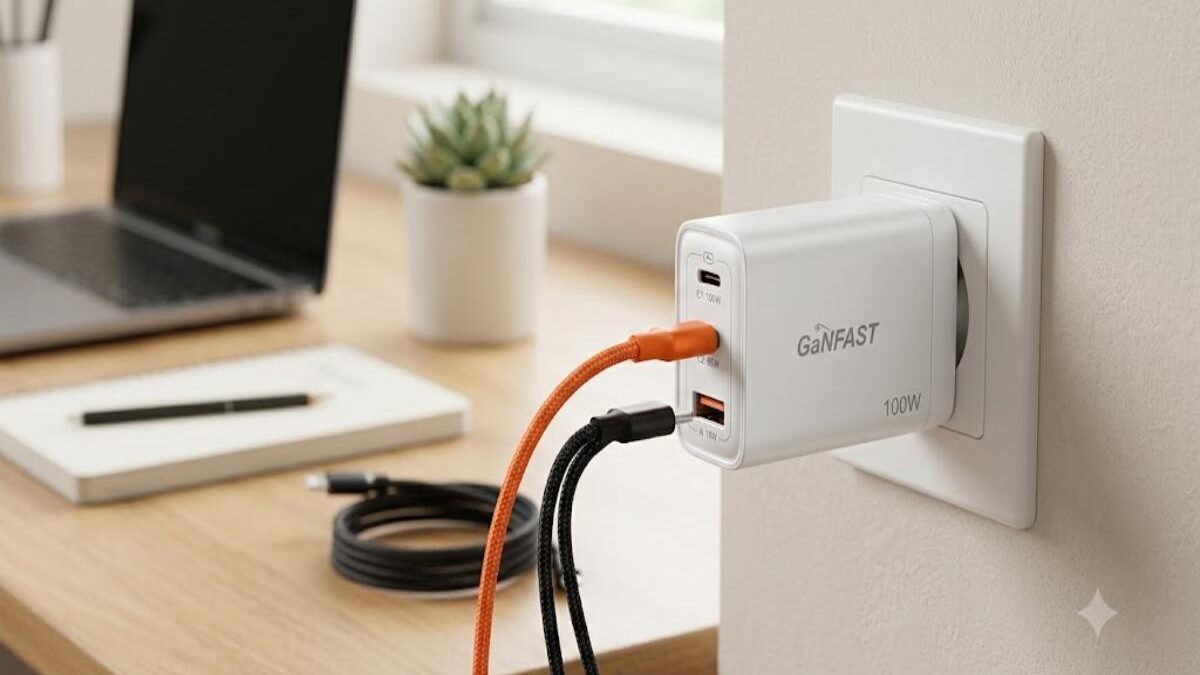
Charging technology has changed significantly as smartphones, tablets and laptops have become essential for everyday activities. While traditional chargers continue to serve their purpose, users increasingly require compact charging accessories that support higher power outputs and multiple devices.
A GaN charger uses Gallium Nitride semiconductor technology instead of conventional silicon-based power switching components. This technology makes it possible to develop smaller, more power-efficient charging adapters without sacrificing their rated output.
Whether you need a charger for your smartphone, laptop or everyday travel, understanding the advantages of GaN technology can help you make an informed decision. Here are 10 reasons why GaN chargers are worth considering over traditional charging adapters.
1. Compact Design That Takes Up Less Space
One of the most noticeable advantages of a GaN charger is its compact construction. Gallium Nitride technology allows power components to operate efficiently at higher switching frequencies, enabling manufacturers to use smaller supporting components.
As a result, a GaN charger can provide similar or higher charging output in a smaller body than many conventional silicon-based adapters.
Key Benefits:
- Compact dimensions for convenient storage
- Less space required inside travel bags
- Smaller charging accessories for workstations
- Easier portability during daily commuting
For people carrying smartphones, tablets and laptops, a compact charging adapter can help reduce the space occupied by electronic accessories.
2. Higher Power Efficiency During Charging
Power efficiency is an important consideration when comparing different charger technologies. Traditional silicon-based chargers lose some electrical energy as heat during power conversion.
GaN components can reduce switching losses, helping manufacturers create efficient power conversion systems. This can reduce wasted energy, particularly in well-designed high-output charging adapters.
Key Benefits:
- Reduced power conversion losses
- Efficient energy transfer
- Potentially lower wasted energy
- Suitable performance across different charging requirements
However, actual efficiency depends on the charger’s complete circuit design, operating load and quality of components rather than semiconductor material alone.
3. Supports Fast Charging for Compatible Devices
Fast charging is one of the main considerations when purchasing a new adapter. GaN technology supports the development of compact chargers capable of delivering higher power outputs.
Many GaN chargers offer USB Power Delivery or other supported fast-charging protocols, allowing compatible devices to receive power according to their charging requirements.
For example, a 45W GaN charger may support charging for compatible smartphones, tablets and certain laptops.
Key Benefits:
- Higher charging outputs in compact designs
- Support for compatible fast-charging protocols
- Reduced charging time compared with lower-output adapters
- Convenient charging between work or travel activities
It is important to remember that GaN technology itself does not automatically increase charging speed. The charger’s wattage, charging protocol, cable and connected device determine the actual performance.
4. Better Thermal Efficiency and Heat Management
Electronic chargers generate heat while converting electricity into the voltage and current required by connected devices.
GaN power components can operate with lower switching losses than comparable silicon components, helping improve power conversion efficiency.
This can make thermal management easier in high-output chargers. However, compact GaN adapters can still become warm during use, especially when operating near their maximum rated output.
Key Benefits:
- Potentially reduced heat-related energy losses
- Efficient operation at higher switching frequencies
- Support for compact thermal designs
- Improved power management in suitable circuit designs
Users should select chargers with appropriate temperature protection and avoid covering charging adapters during operation.
5. Convenient Charging for iPhones and Other Smartphones
Modern smartphones support different charging speeds and protocols. A compatible GaN adapter can provide the required power while maintaining a compact design.
For Apple users, choosing a suitable iPhone charger involves checking USB Power Delivery compatibility, the iPhone model and the charging cable.
Many recent iPhones support USB-C charging, while older models use Lightning connectors. A compatible USB-C Power Delivery adapter can support fast charging when paired with the appropriate cable.
Key Benefits:
- USB Power Delivery support on compatible models
- Compact charging adapters for travel
- Compatibility with supported Android and Apple devices
- Multiple wattage options for different charging needs
A higher-wattage GaN charger does not necessarily charge an iPhone faster than a suitable lower-wattage adapter. The smartphone regulates how much power it draws.
6. One Charger Can Support Multiple Devices
Carrying separate charging adapters for smartphones, tablets and laptops can increase cable clutter and luggage weight.
High-output GaN chargers can support several device categories through compatible USB charging protocols. Some models also provide multiple USB-C and USB-A ports for simultaneous charging.
For example, a suitable 65W or 100W GaN charger may support charging for a USB-C laptop alongside smaller electronic devices.
Key Benefits:
- Reduced dependence on separate adapters
- Compatibility with different device categories
- Multi-port charging on supported models
- Convenient charging arrangements for shared workspaces
Before connecting several devices, check how the charger distributes total wattage across its ports. Simultaneous charging may reduce the output available to each connected device.
7۔ Easier to Carry During Travel and Daily Commuting
Frequent travellers often prioritise compact accessories that are easy to carry. GaN chargers are useful in this situation because high-output models can be smaller than many traditional adapters with similar capabilities.
A single compatible adapter may charge your smartphone, tablet and laptop, reducing the number of chargers required during a trip.
Key Benefits:
- Lightweight and space-saving options
- Convenient storage in backpacks and laptop bags
- Fewer charging adapters to carry
- Useful for business trips and daily commuting
Some GaN chargers also support wide AC input voltage ranges, making them practical for international travel when used with the correct plug adapter. Always verify the supported input voltage before connecting a charger abroad.
8۔ Suitable for Higher-Wattage Laptop Charging
Laptops generally require greater charging power than smartphones. Traditional laptop adapters can be relatively large, particularly for devices with demanding power requirements.
GaN technology allows manufacturers to produce compact chargers with outputs such as 65W, 67W and 100W.
These chargers can support compatible USB-C laptops, provided their output meets the laptop’s charging specifications.
Key Benefits:
- High power output in a compact adapter
- USB-C Power Delivery support
- Convenient charging for remote work
- Reduced need for separate laptop and smartphone adapters
Ambrane offers GaN charging options such as the Charge 67 and Charge 100 for compatible high-power devices.
Before purchasing, confirm that your laptop supports USB-C charging and check its required power output. Some high-performance laptops need more power than a compact charger can supply.
9۔ Flexible Charging Options for Different Workstations
People working from home or in an office often use several devices throughout the day, including laptops, smartphones, tablets and wireless accessories.
Multi-port GaN chargers can simplify these setups by allowing compatible devices to share one charging adapter.
This can reduce the number of wall outlets occupied by separate charging blocks and make charging cables easier to organise.
Key Benefits:
- More organised desk charging
- Multiple charging connections on selected models
- Convenient switching between devices
- Reduced dependence on several bulky adapters
The Ambrane Charge 70, for example, is a 70W GaN-based wall charger with triple-output connectivity.
When setting up a workstation, check the total power requirement of connected devices and use appropriate cables for each charging connection.
10۔ Practical Charging Technology for Long-Term Device Use
As more electronic devices adopt USB-C charging, users may prefer adapters that support different charging requirements instead of purchasing separate chargers for every device.
A compatible multi-port GaN charger can support various smartphones, tablets and USB-C laptops, making it a practical option for households using multiple electronic devices.
Its usefulness over time depends on supported charging protocols, output wattage and build quality rather than GaN technology alone.
Key Benefits:
- Compatibility with several USB-powered device categories
- Different wattage configurations
- Convenient multi-device charging
- Potential to reduce the number of adapters required
Selecting a charger with suitable power output and reliable protection features can help maintain a flexible charging setup as your devices change.
GaN Charger vs Traditional Charger: Key Differences
Although both charger types convert AC electricity into usable DC power, their construction and performance characteristics can differ.
| Feature | GaN Charger | Traditional Silicon Charger |
| Semiconductor technology | Gallium Nitride power components | Silicon power components |
| Physical size | Often more compact at similar output levels | May require larger components |
| Energy efficiency | Can offer lower switching losses | Depends on circuit design |
| Charging speed | Depends on wattage and protocol | Depends on wattage and protocol |
| Heat management | Can support efficient thermal designs | Depends on components and construction |
| Multi-device charging | Available on selected models | Available on selected models |
| Price | May cost more than comparable basic adapters | Basic models may be less expensive |
The primary difference is the power conversion technology. Both GaN and silicon chargers can support fast charging, but GaN technology offers advantages when manufacturers need compact, efficient high-output designs.
How to Choose the Right GaN Charger for Your Devices
Before purchasing a GaN charger, evaluate your devices and their charging requirements.
Check the Required Charging Wattage
Different electronic devices have different power requirements.
- 20W–30W: Suitable for many smartphones
- 30W–45W: Suitable for compatible smartphones and tablets
- 45W–65W: Can support certain USB-C laptops
- 67W–100W: Suitable for compatible higher-power laptops and multi-device charging
These are general ranges. Always verify the actual charging specifications of your device.
Compare USB Port Configurations
A single-port charger may be sufficient for charging one device at a time. Multi-port models provide additional convenience when charging smartphones, laptops and accessories together.
Verify Charging Protocol Compatibility
Look for USB Power Delivery and other charging protocols supported by your devices. Charging performance depends on the compatibility between the charger, cable and connected equipment.
Consider Portability and Safety
Choose a charger with dimensions that suit your routine. Check applicable certifications, manufacturer specifications and built-in protections against overcurrent, short circuits and overheating.
Conclusion
GaN chargers offer several advantages over conventional silicon-based charging adapters, particularly in terms of compact design, power efficiency and high-output charging capabilities.
Their smaller form factors make them practical for travel, while compatible multi-port models can simplify charging arrangements at home and work. Users with laptops, tablets and smartphones may also benefit from carrying fewer charging adapters.
However, GaN technology alone does not guarantee faster charging, lower operating temperatures or longer product life. Before selecting a charger, compare its wattage, supported protocols, port configuration and safety features with your device requirements.
Top 10 Reasons to Choose a GaN Charger Over a Traditional Charger