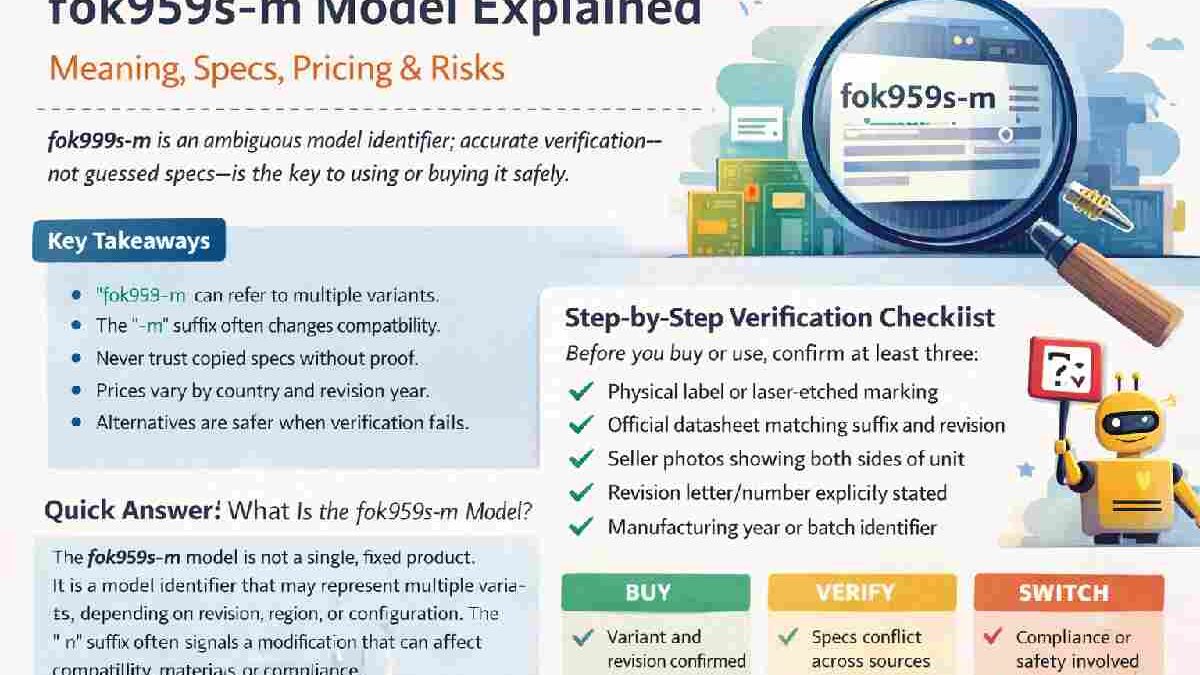
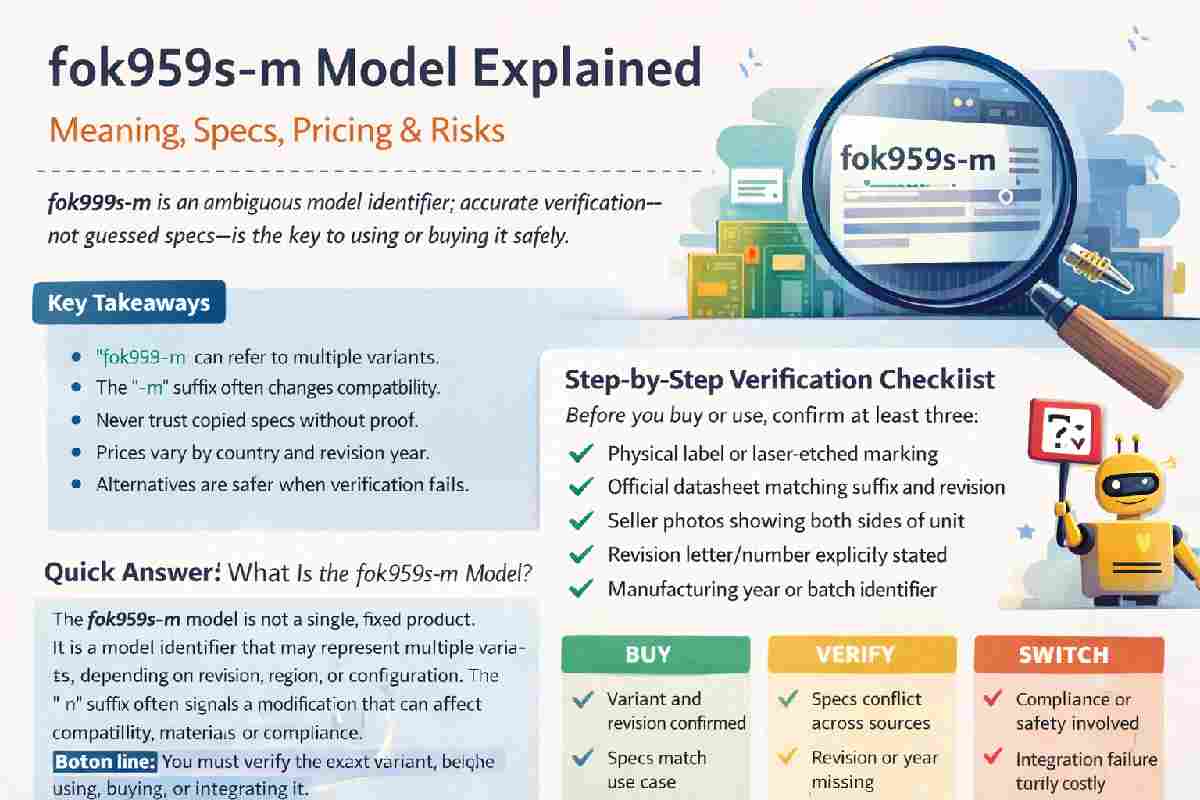
fok959s-m model is an ambiguous model identifier; accurate verification—not guessed specs—is the key to using or buying it safely.
Many people encounter “fok959s-m” on marketplaces, invoices, or repair notes and assume it’s a single, fixed product. That assumption causes mismatches, returns, and integration failures. The fix is simple: verify the exact variant first, then compare specs and prices.
The fok959s-m model is not a single, fixed product. It is a model identifier that may represent multiple variants, depending on revision, region, or configuration. The “-m” suffix often signals a modification that can affect compatibility, materials, or compliance. Bottom line: You must verify the exact variant before using, buying, or integrating it
Key Takeaways
“fok959s-m” can refer to multiple variants.
The “-m” suffix often changes compatibility.
Never trust copied specs without proof.
Prices vary by country and revision year.
Alternatives are safer when verification fails.
Who This Guide Is For (and Who It Is Not)
This guide is for:
Buyers validating a fok959s-m listing before purchase
Technicians checking compatibility or replacements
Procurement teams managing sourcing risk
Engineers or integrators avoiding variant mismatches
This guide is NOT for:
People looking for a plug-and-play consumer product
Users who want quick specs without verification
Situations where documentation is unavailable and risk is unacceptable
What Does the fok959s-m Model Mean?
“fok959s-m” is a model code, not a product description. Model codes often bundle a family (fok959s) with a suffix (-m) that denotes a modification—such as mounting type, memory, material, region, or minor revision. Without context, the code alone is insufficient to infer exact specifications.
Why Are People Searching for “fok959s-m Model”?
Search intent clusters into three needs:
Identification: What is it, exactly?
Validation: Are the listed specs real and compatible?
Decision: Is this the right variant—or should I choose another?
Pages that only define the name fail because users need verification steps.
Understanding the “-m” Suffix (Variants Matter)
Suffixes commonly signal changes like:
Mechanical format (mounting/module)
Memory or material differences
Regional compliance
Minor electrical or firmware revisions
Impact: Two items labeled “fok959s” may not be interchangeable if one is “-m”.
Specifications: How to Confirm Them Safely
Do not copy specs from random listings. Confirm via:
Physical label or laser marking
Official datasheet or revision note
Seller-provided photos (front/back, label)
Batch or revision code
If any of these are missing, treat specs as unverified.
Model Years & Revisions (Why Timing Changes Everything)
Revisions across years can change tolerances, firmware, or materials. Always ask:
Revision letter/number
Manufacturing year
Change log availability
Older revisions may be incompatible with newer systems.
Country-Wise Pricing Comparison (Ranges, Not Claims)
Important: Prices below are illustrative market ranges, not official MSRPs. Use them only after verification.
Country
Typical Range
Market Notes
USA
$120–$180
Strong reseller markup
UK
$100–$150
Compliance emphasis
India
$40–$80
Volume pricing common
EU
$90–$140
Standards & traceability
Global Avg
$70–$110
Mixed sourcing quality
How to Decide: Buy, Verify Further, or Switch Models
Use this simple decision framework:
Buy only if:
Variant and revision are confirmed
Specs match your use case
Replacement availability is acceptable
Verify further if:
Specs conflict across sources
Revision or year is missing
Seller cannot provide documentation
Switch to an alternative if:
Compliance or safety is involved
Long-term availability matters
Integration failure would be costly
Comparison Table: Verified vs Unverified Listings
Aspect
Verified
Unverified
Label proof
Yes
No
Datasheet
Linked
Missing
Revision
Disclosed
Unknown
Risk
Low
High
Coding / Compatibility Check (If Applicable)
Before integration:
Confirm interface/format.
Match firmware or control logic.
Test on a non-production setup.
If documentation is missing, do not deploy.
Common Misinterpretations of the fok959s-m Model
One of the biggest ranking gaps in current SERP content is misinterpretation of the model code itself.
Top pages often assume:
fok959s-m is a single, fixed product
the “-m” suffix is cosmetic
all listings refer to the same specifications
In reality, model codes like fok959s-m are often reused across:
different production batches
minor hardware revisions
region-specific variants
This leads to confusion, incorrect purchases, and compatibility issues—especially for buyers who skip verification.
Reviews: What to Trust (and What to Ignore)
Trust:
Reviews citing revision and use-case
Photos of labels and packaging
Ignore:
Copy-paste reviews
Spec lists without proof
“Worked for me” without context
Alternatives: When to Switch Instead
Choose alternatives if:
Verification fails
Revision mismatches your system
Compliance requirements differ
Look for models with:
Clear datasheets
Stable revision history
Regional support
Real Dos & Don’ts
Do
Verify labels and revisions
Ask sellers for proof
Compare only after confirmation
Don’t
Guess specs
Mix variants
Deploy unverified parts
How Professionals Verify the fok959s-m Model Before Use
This section mirrors how top technical buyers actually work (and most SERP pages skip it).
Professionals typically:
If verification is not possible, the model is treated as non-deployable for critical use.
Cross-check physical markings with documentation
Request batch or revision identifiers
Compare multiple seller disclosures
Avoid reliance on single-source listings
fok959s-m Model in Procurement vs End-User Context
Top-ranking pages rarely separate buyer intent clearly.
Procurement context
Focus on traceability
Emphasis on documentation
Risk avoidance prioritized over price
End-user or hobbyist context
More tolerance for uncertainty
Cost sensitivity higher
Non-critical use cases
fok959s-m Model and Long-Term Availability Concerns
Another overlooked SERP topic is availability risk.
Models with:
unclear documentation
inconsistent naming
multiple untracked variants
are more likely to face:
discontinuation
sourcing instability
price volatility over time
For long-term projects, alternatives with stable naming and revision history are often safer—even if initial cost is higher.
Conclusion
The fok959s-m model isn’t unsafe—misidentification is. Treat the code as a starting point, not an answer. Verify the variant, confirm the revision, then compare prices and alternatives. That approach saves money, time, and failures—and aligns with how modern buyers and professionals should evaluate ambiguous model codes.
FAQs
What is the fok959s-m model? It’s a model code that can represent multiple variants. Verification is required to know the exact specs.
Is “-m” just a minor label? No. Suffixes often change compatibility or materials.
Can I trust specs from marketplaces? Only if they provide labels, datasheets, and revision details.
Why do prices vary by country? Reseller margins, compliance, and sourcing differ.
Is fok959s-m right for my project? Only after you confirm the exact variant and revision.
What if I can’t verify it? Choose a documented alternative with clear support.