

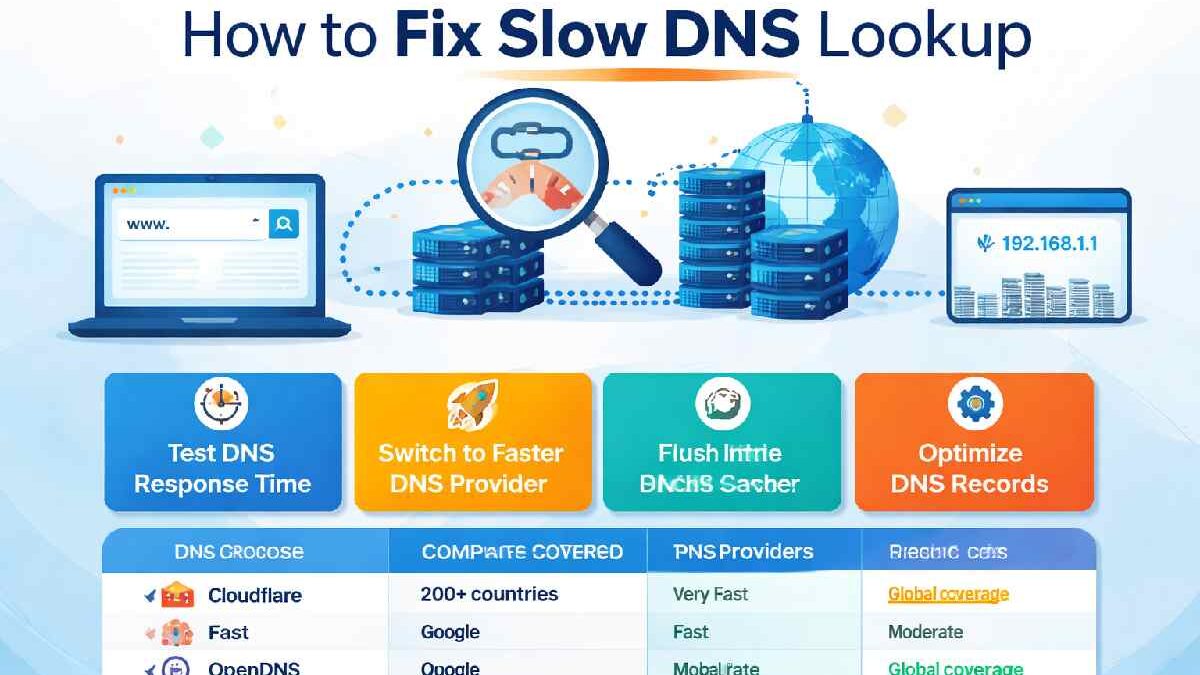
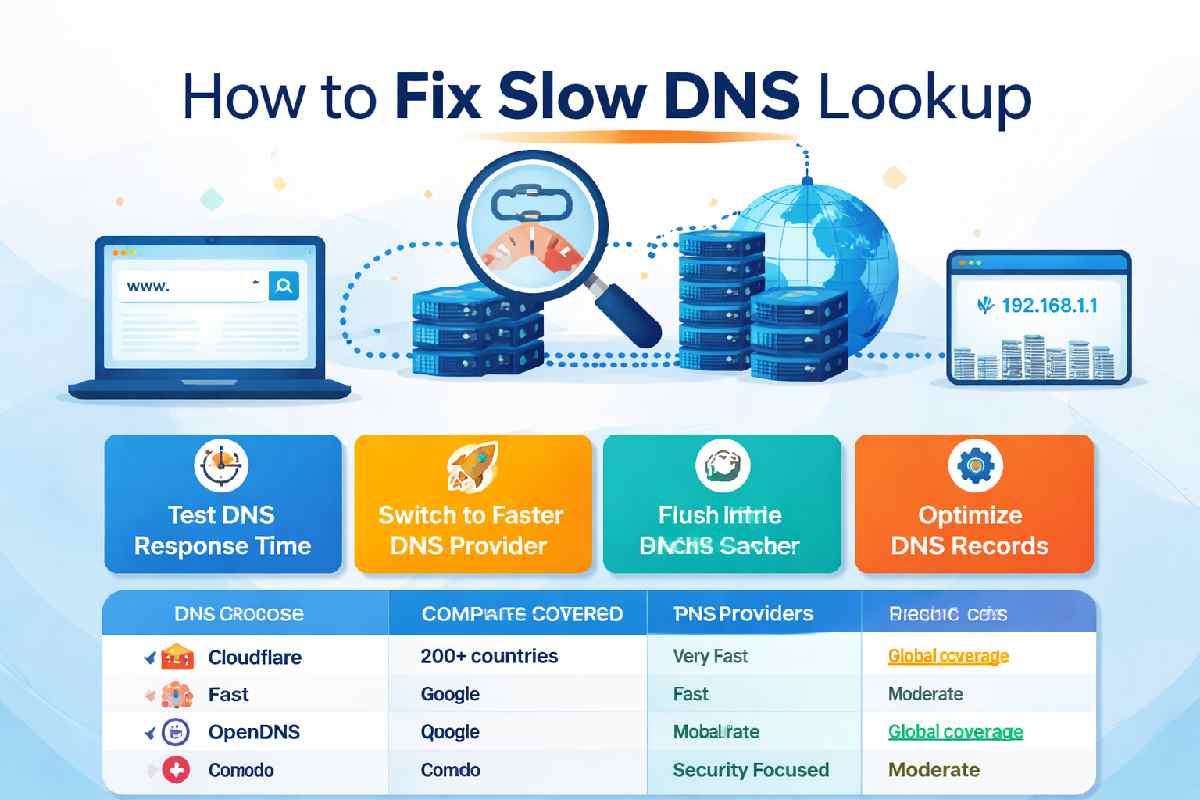
Slow DNS lookup is usually not a single problem but a chain of delays between your device, DNS resolver, and authoritative servers. Fixing it requires identifying where the latency occurs and optimizing that specific layer.
When websites feel slow, many people immediately blame hosting or internet speed. However, the first delay often happens before the website even starts loading: DNS lookup.
If DNS resolution takes too long, your browser cannot find the server that hosts the website. Even a delay of a few hundred milliseconds can significantly affect perceived website speed.
The good news is that DNS latency is often fixable with targeted troubleshooting.
Key Takeaways
-
Slow DNS lookup often originates from resolver latency, misconfigured DNS records, or geographic distance.
-
Switching to faster DNS providers like Cloudflare or Google DNS improves lookup performance.
-
DNS caching dramatically reduces repeat lookup delays.
-
Website owners should optimize authoritative DNS infrastructure.
-
Diagnosing DNS issues requires checking multiple layers of the DNS resolution chain.
Why Slow DNS Lookup Happens
DNS works like the internet’s phonebook. When you type a website name into your browser, DNS servers translate that name into an IP address.
The process involves multiple steps.
The DNS Resolution Chain
-
Your device sends a DNS request.
-
A recursive resolver searches for the IP address.
-
The authoritative DNS server returns the final answer.
Each step introduces potential latency.
For example:
-
Local device misconfiguration
-
Slow ISP DNS servers
-
Overloaded authoritative DNS infrastructure
If any part of this chain becomes inefficient, DNS lookup time increases.
Common Causes of Slow DNS
Several factors commonly cause slow DNS lookup times.
1. Slow DNS providers
Some internet service providers run outdated DNS infrastructure. This can introduce delays during resolution.
2. Geographic distance
If the DNS server is far away geographically, latency increases.
3. Poor DNS caching
Incorrect TTL settings prevent efficient caching.
4. Misconfigured DNS records
Too many lookups or chained records can slow down resolution.
How to Diagnose Slow DNS Lookup
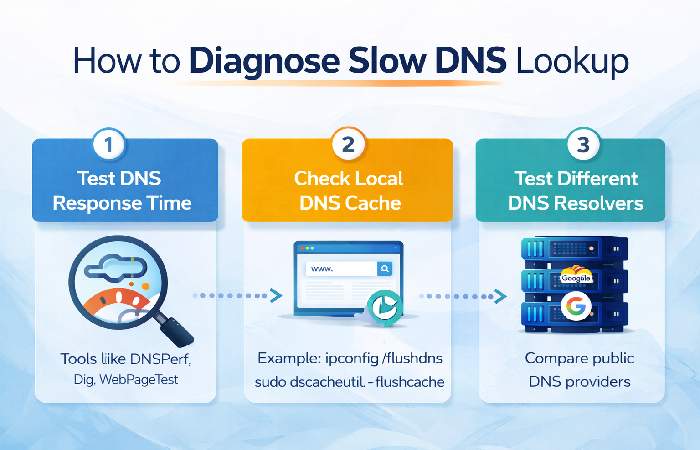
Before fixing DNS issues, it is important to determine where the slowdown occurs.
Step 1: Test DNS Response Time
Use tools like:
-
DNSPerf
-
Google Dig tool
-
WebPageTest
These tools help measure lookup latency.
Example:
A DNS response time above 150–200 ms may indicate a problem.
Step 2: Check Local DNS Cache
Operating systems store cached DNS responses.
If the cache becomes corrupted or outdated, lookups may slow down.
You can flush DNS cache using commands such as:
Windows
MacOS
Linux
Step 3: Test Different DNS Resolvers
Changing DNS providers can significantly reduce lookup time.
Here are common options:
| DNS Provider | Countries Covered | Performance | Pricing |
|---|---|---|---|
| Cloudflare DNS | 200+ | Very fast | Free |
| Google Public DNS | Global | Fast | Free |
| OpenDNS | Global | Moderate | Free/Paid |
| Quad9 | Global | Security focused | Free |
| Comodo Secure DNS | Global | Moderate | Free |
Global DNS Performance Comparison
DNS performance also varies by country depending on infrastructure.
| Country | Typical DNS Latency | Major Providers | Infrastructure |
|---|---|---|---|
| USA | 20-40 ms | Cloudflare, Google | Excellent |
| UK | 25-45 ms | Cloudflare, OpenDNS | Excellent |
| Germany | 30-50 ms | Google, Quad9 | Strong |
| India | 40-80 ms | Cloudflare, Google | Growing |
| Australia | 30-60 ms | Cloudflare, Google | Strong |
Countries with strong internet infrastructure tend to experience faster DNS resolution.
Real-World Example of DNS Latency
Consider a small e-commerce website.
The site loads slowly despite good hosting.
A DNS test reveals:
-
Resolver latency: 180 ms
-
Authoritative DNS response: 50 ms
Total lookup time: 230 ms.
Switching the DNS provider to Cloudflare reduces resolver latency to 25 ms, improving overall page load speed.
Advanced DNS Optimization Strategies
For businesses or high-traffic websites, deeper DNS optimization may be necessary.
Use Anycast DNS
Anycast routing distributes DNS requests across multiple global servers.
This reduces latency for international users.
Integrate CDN Services
Content delivery networks often include optimized DNS infrastructure.
Providers like Cloudflare, Akamai, and Fastly improve both DNS performance and content delivery.
Monitor DNS Performance
Regular monitoring helps detect issues early.
Tools like DNSPerf and Pingdom can track DNS performance trends.
Conclusion
Slow DNS lookup is a hidden performance bottleneck that affects website speed and browsing experience.
The key is identifying where latency occurs—whether on the local device, DNS resolver, or authoritative server.
Simple actions such as switching DNS providers, optimizing TTL values, and monitoring DNS infrastructure can dramatically improve lookup performance.
For businesses running high-traffic websites, investing in robust DNS infrastructure and CDN integration can make a measurable difference in user experience.
FAQS
1. What causes slow DNS lookup?
Slow DNS lookup usually happens when DNS servers respond slowly, caching is misconfigured, or the resolver is geographically distant. ISP DNS congestion is also a common cause.
2. How can I quickly fix slow DNS lookup?
The fastest solution is switching to a faster public DNS provider such as Cloudflare DNS or Google Public DNS. Clearing your DNS cache can also resolve temporary issues.
3. Is slow DNS lookup a hosting problem?
Not always. DNS lookup occurs before a browser connects to a hosting server. In many cases, the delay comes from DNS resolvers or caching configuration rather than hosting.
4. Does DNS affect website speed?
Yes. DNS lookup is the first step in loading a website. If it takes too long, the browser cannot connect to the server quickly, increasing overall page load time.
5. Which DNS provider is the fastest?
Cloudflare DNS and Google Public DNS consistently rank among the fastest global DNS providers according to performance tests by DNSPerf.
6. Should website owners change DNS providers?
Yes, if DNS resolution is slow. Modern DNS providers often offer better infrastructure, global servers, and improved reliability.
7. How do I test DNS speed?
Tools like DNSPerf, WebPageTest, and command-line utilities such as Dig can measure DNS response times.
8. Does CDN improve DNS speed?
Yes. Many CDN providers include globally distributed DNS networks that significantly reduce lookup latency.
9. Can DNS configuration affect SEO?
Indirectly, yes. Faster DNS resolution improves website speed, and page speed is a ranking factor in search engines.
10. Is DNS lookup slow on mobile networks?
Mobile networks sometimes introduce additional DNS latency due to network routing and resolver infrastructure. Switching to public DNS services may improve performance.
