

There’s a version of IT consulting that’s easy to find and not particularly hard to hire: a technician who fixes what’s broken, installs what you ask for, and sends an invoice. Useful. Limited. Not quite what most growing businesses need.
There’s another version — the kind that builds something. That takes the time to understand how the business works, where it’s going, what the technology environment actually looks like beneath the surface, and what it would take to make technology a genuine asset rather than a recurring expense. That version is harder to find, and it’s worth understanding what separates the two.
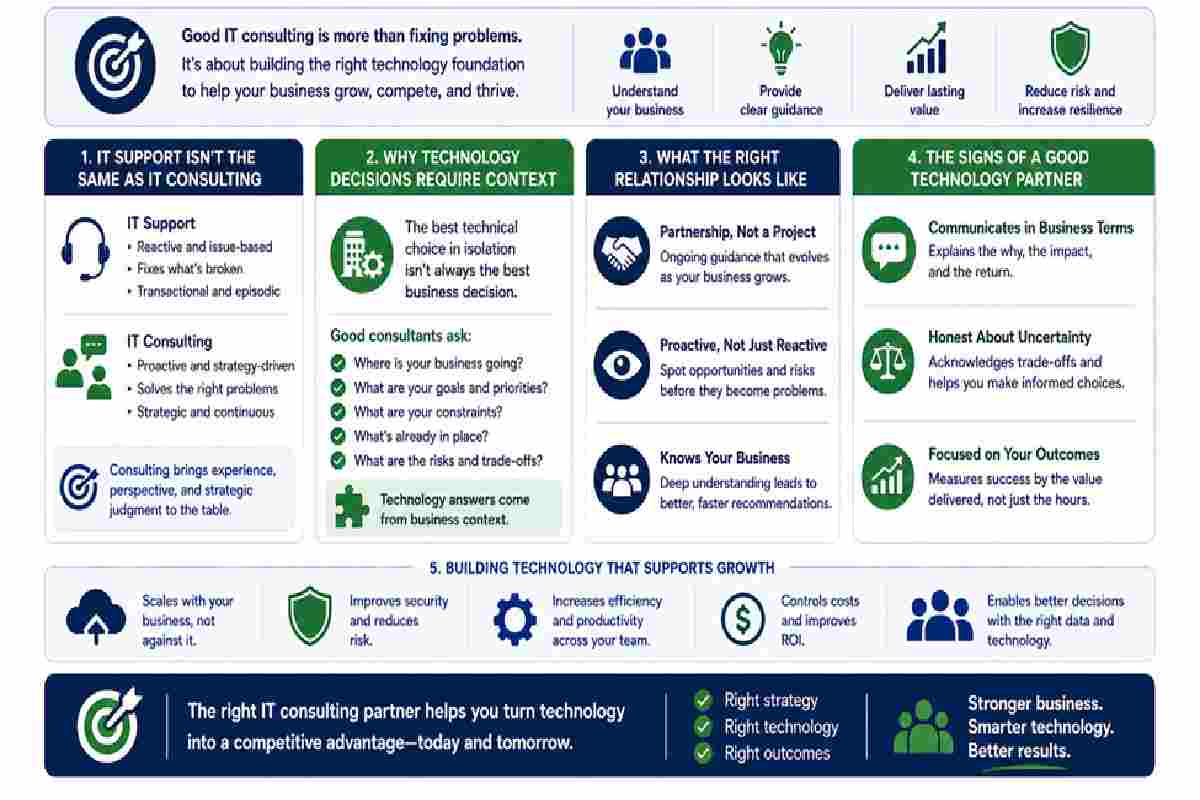
IT Support Isn’t the Same as IT Consulting
The distinction matters in practice, not just in category. IT support is reactive — someone calls, a problem gets solved, the engagement ends. It’s transactional and episodic by design. There’s nothing wrong with it. Businesses need technical support. But they also need something that support doesn’t provide.
IT consulting is about judgment applied to a specific business context. A consultant doesn’t just know how to configure a system — they know how to think about whether that system is the right one, what the tradeoffs are, and how a decision fits into a larger technology strategy. They bring a perspective that comes from working across multiple organizations and environments, which means they’ve seen what works and what doesn’t in ways that an internal team confined to one organization rarely can.
For businesses navigating technology decisions — cloud migration, security posture, software stack consolidation, infrastructure scaling — that kind of judgment is the thing that makes the engagement valuable.
Why Technology Decisions Require Context
The best technical decision in isolation is often not the best business decision in context.
A consultant recommending a move to a specific cloud platform might be technically correct that it’s a capable platform. But if that platform has poor integration with the ERP system the business runs its operations on, or if the migration timeline conflicts with a critical busy season, or if the cost model doesn’t fit the business’s cash flow pattern, then the technically sound recommendation becomes a practically problematic one.
Good IT consulting in Calgary — or anywhere — requires consultants who ask business questions, not just technical ones. Who is making what decisions? What does the business need this technology environment to support in the next two years? What are the constraints — budget, timeline, internal capacity, vendor relationships? What’s already been decided that we need to work around?
The technology answers come from the business context. Without that context, even technically excellent advice misses the mark.
What the Right Relationship Looks Like
Businesses that get sustained value from IT consulting typically have a relationship that looks more like a partnership than a project.
Projects have endpoints. The consulting engagement delivers a recommendation, or completes a migration, or finishes a security audit. The work is done, the invoice is paid, and the relationship concludes. This works fine for well-defined, bounded problems.
The ongoing technology management of a growing business isn’t that. It’s continuous, evolving, and connected to business changes that aren’t predictable from the beginning. The company that starts with fifteen employees and grows to sixty over three years doesn’t need a point-in-time IT strategy — it needs an IT partner who’s been paying attention as the business changed and can advise based on that accumulated understanding.
Many businesses that work with experienced it consulting calgary professionals find the most value in relationships where the consultant knows the business well enough to provide proactive input — flagging something before it becomes a problem, recommending an investment before the need is urgent, identifying a risk before it’s an incident.
The Signs of a Good Technology Partner
It’s worth being concrete about what good looks like, because the marketing language in the IT consulting space tends toward vagueness.
A strong technology partner communicates in business terms, not just technical ones. When they recommend an investment, they can explain the business case: what risk does this address, what capability does it enable, what’s the expected return, and what’s the cost of not doing it? If every recommendation comes with dense technical explanation and no business rationale, the consultant isn’t bridging the gap they should be.
They’re honest about uncertainty. Technology decisions involve tradeoffs and imperfect information. A consultant who presents every recommendation with total confidence should prompt skepticism. Good advice acknowledges the limits of what can be known and helps you make the best decision given those limits.
They measure themselves against your outcomes, not their activity. Billing for hours spent is not the same as delivering business value. The consultants worth keeping are the ones who are genuinely interested in whether the business is better off as a result of their work.
Building Technology That Supports Growth
Business environment is competitive enough that technology decisions compound over time. The businesses that build coherent, well-managed technology environments early tend to scale more smoothly than the ones that defer those decisions and deal with the accumulated technical debt later.
This is where IT consulting creates its clearest value. Not in the immediate fix of an acute problem, but in the longer arc of building a technology foundation that supports where the business is going — one that scales when the business scales, that doesn’t create new problems as it grows, and that gives leadership real visibility into how technology is performing against business objectives.
That’s a different engagement than calling someone to fix the server. And for businesses at the stage where technology decisions have material consequences for growth, it’s a different and more important one.